
What Is WhatsApp Business API?
WhatsApp Business API, now part of the WhatsApp Business Platform, allows businesses to communicate with customers through WhatsApp at scale.
It is designed for businesses that need more than the standard WhatsApp Business app.
Businesses can use it for:
- Marketing campaigns
- Order notifications
- Appointment reminders
- Customer support
- OTP and authentication
- Lead notifications
- Automated replies
- Chatbots
- CRM integrations
- Team inboxes
- Customer follow-ups
The platform can be accessed directly through Meta's Cloud API or through a Business Solution Provider (BSP) or software platform.
WhatsApp's policies also require businesses to follow its messaging rules, including using approved templates when initiating business-initiated conversations and respecting customer opt-outs.
How WhatsApp API Pricing Works in India in 2026
One of the biggest changes businesses need to understand is that WhatsApp moved to a per-message pricing model.
Instead of thinking only about a monthly conversation package, businesses need to consider the category and number of messages they send.
The major categories include:
Marketing
Used for promotional and marketing communication.
Examples:
- Offers
- Discounts
- Product promotions
- New launches
- Promotional campaigns
- Retargeting messages
Utility
Used for transactional or customer-requested updates.
Examples:
- Order updates
- Booking confirmations
- Delivery updates
- Account notifications
- Payment updates
Authentication
Used for authentication-related communication such as OTPs.
Service
Used when responding to customer-initiated conversations within the applicable customer-service window.
WhatsApp API Rates in India
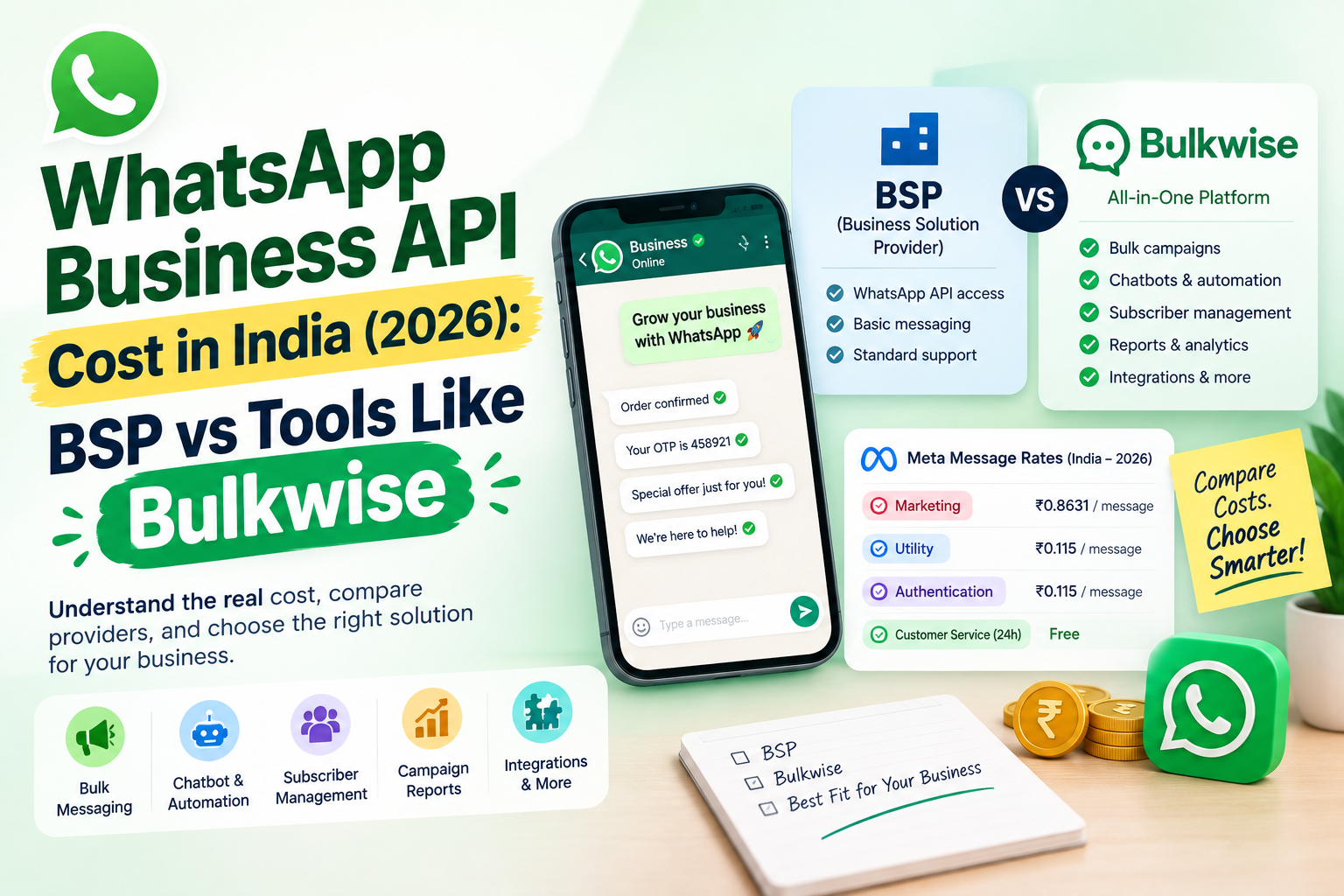
Based on 2026 India pricing information, Meta's rates are approximately:
| Message CategoryApprox. Meta Rate | |
| Marketing | ₹0.8631/message |
| Utility | ₹0.115/message |
| Authentication | ₹0.115/message |
| Customer service within applicable 24-hour window | Free |
These are Meta-level charges, not necessarily the final amount you pay to a software provider.
For example, if you send:
10,000 marketing messages
Meta messaging cost would be approximately:
10,000 × ₹0.8631 = ₹8,631
before applicable provider charges and taxes.
Why Is There a Difference Between BSP Pricing and WhatsApp Pricing?
This is where many businesses get confused.
Meta provides the WhatsApp Business Platform, but many businesses use another company to provide the software layer around it.
That company may be a:
BSP (Business Solution Provider)
or a WhatsApp automation platform built around the API.
So your total cost can look like:
Meta Charges
Platform/BSP Fee
Provider Markup, if applicable
GST
This means two companies can use the same WhatsApp infrastructure but have different total monthly costs.
What Does a BSP Charge?
A BSP may charge businesses through one or more of the following models:
1. Monthly Platform Fee
You pay a fixed monthly subscription.
For example:
₹1,500/month
or
₹3,000/month
depending on the provider and plan.
2. Per-Message Markup
Some providers add a markup on top of Meta's message cost.
For example:
Meta Cost → ₹0.8631
Provider Price → Higher than Meta's base rate
3. Setup or Onboarding Fees
Some providers may charge separately for:
- Onboarding
- API setup
- Integration
- Template setup
- Chatbot setup
- Technical support
Not every provider uses all of these charges.
What Is Bulkwise?
Bulkwise is a WhatsApp automation platform that combines WhatsApp messaging with business automation features.
Instead of using the API only for sending messages, businesses can use a platform such as Bulkwise for activities including:
- Bulk broadcasting
- Chatbots
- Campaigns
- Subscriber management
- Template management
- Team inbox
- Automation
- API integration
- Webhooks
- Campaign reporting
- Scheduling
- WhatsApp catalog
- CRM and other integrations
This can be useful for businesses that want a complete WhatsApp marketing and automation system rather than only API connectivity.
Bulkwise WhatsApp Pricing in India
According to Bulkwise's current pricing page, its WhatsApp plans include platform access along with message pricing.
The listed India rates are:
Marketing Message: ₹0.88
Utility Message: ₹0.13
Bulkwise currently lists subscription options including:
3 Months: ₹7,499 promotional price
12 Months: ₹24,999 promotional price
The listed plans include features such as unlimited subscribers, bulk broadcasting, chatbot building, drip campaigns, template management, campaign reports, team members, API integrations, webhooks, scheduling, and more. GST is applicable separately.
Because pricing and promotional offers can change, businesses should check the current pricing page before purchasing.
BSP vs WhatsApp Automation Tool
So, should a business choose a traditional BSP or a complete WhatsApp automation platform?
It depends on what the business needs.
| RequirementBasic BSP/API ProviderWhatsApp Automation Platform | ||
| WhatsApp API access | Yes | Yes |
| Template messaging | Yes | Yes |
| Marketing campaigns | Depends | Yes |
| Bulk broadcasting | Depends | Yes |
| Chatbot | Depends | Yes |
| Automation workflows | Depends | Yes |
| Team inbox | Depends | Yes |
| Subscriber management | Depends | Yes |
| Campaign reports | Depends | Yes |
| API integration | Yes | Yes |
| Webhooks | Depends | Yes |
| Scheduling | Depends | Yes |
A business that only needs API connectivity may prefer a simpler provider.
A business that wants marketing + automation + customer management + campaigns may benefit from an all-in-one platform.
Example: 10,000 Marketing Messages
Let's take a simple example.
Suppose an Indian business wants to send:
10,000 marketing messages per month.
Using the approximate Meta India marketing rate of ₹0.8631:
10,000 × ₹0.8631 = ₹8,631
That's the approximate Meta messaging component.
Now add the platform cost.
The final bill can therefore look like:
Meta Messaging Cost
₹8,631
Platform/BSP Fee
GST
The important point is that the advertised monthly software price and the WhatsApp messaging cost are not always the same thing.
Example: 50,000 Marketing Messages
Now consider a larger campaign.
50,000 × ₹0.8631
= ₹43,155
Again, this is only the approximate Meta messaging component based on the 2026 India rate.
Add:
Platform Fee + Any Provider Markup + GST
and the actual monthly expense will be higher.
This is why businesses should calculate their expected message volume before selecting a provider.
What About Customer-Initiated Messages?
This is another important area.
When a customer starts a conversation, businesses can respond within the applicable customer-service window without treating every response like a new marketing campaign.
WhatsApp's business messaging policy allows businesses to respond without templates within 24 hours of the customer's latest message, while automated responses are also permitted during that window subject to the platform's requirements.
This makes WhatsApp particularly useful for customer support and lead conversations.
For example:
Customer: "I want to know the price."
↓
Business replies
↓
Customer asks another question
↓
Business continues the conversation
This is different from sending a promotional campaign to a large subscriber list.
Marketing vs Utility: Why the Difference Matters
Businesses should correctly understand message categories.
Marketing Message
"Get 20% off this weekend!"
Utility Message
"Your order #12345 has been shipped."
Authentication
"Your OTP is 458921."
Using the appropriate message category is important for compliance and accurate cost planning.
Businesses should not try to classify promotional messages as utility messages simply to reduce costs.
Why Some Businesses Prefer an All-in-One Tool
Using an API alone does not necessarily give a marketing team everything it needs.
A business may still need:
- Contact management
- Campaign creation
- Template management
- Scheduling
- Chatbots
- Automation
- Analytics
- Team management
- Customer segmentation
An automation platform combines these functions into one interface.
The workflow becomes:
Subscribers
↓
Segment Audience
↓
Create Template
↓
Schedule Campaign
↓
Send Messages
↓
Track Results
↓
Follow Up
This can be easier for marketing and sales teams than building each component separately.
What Should You Compare Before Choosing a Provider?
Don't compare providers based only on the monthly subscription.
Look at:
1. Meta Message Cost
What amount is actually passed through for each message?
2. Platform Fee
Is there a monthly or annual subscription?
3. Message Markup
Does the provider add a markup?
4. Number of Users
How many team members can access the platform?
5. Automation
Can you build automated workflows?
6. Chatbot
Is a chatbot included?
7. Campaigns
Can you schedule and manage bulk campaigns?
8. API Access
Can you integrate WhatsApp with your existing software?
9. Analytics
Can you track delivery, reads, responses, and campaign performance?
10. Support
How quickly can you get help when there is an API or account issue?
The cheapest monthly plan isn't always the cheapest overall solution.
BSP vs Bulkwise: Which Is Better?
There is no single answer for every business.
Choose a simpler BSP/API provider if:
- You have your own development team
- You mainly need API connectivity
- You already have a CRM
- You already have campaign software
- You want to build your own interface
Consider an automation platform like Bulkwise if:
- You want bulk broadcasting
- You need chatbot automation
- You want campaign scheduling
- You need subscriber management
- You want team inbox functionality
- You need campaign reports
- You want APIs and integrations
- You don't want to build your own WhatsApp management system
The key question is:
Do you only need WhatsApp API access, or do you need a complete WhatsApp business automation system?
How to Reduce WhatsApp API Costs
Businesses can manage costs by improving how they use WhatsApp.
Use the Correct Message Category
Don't send everything as marketing.
Avoid Unnecessary Messages
Send useful, relevant communication instead of messaging customers too frequently.
Segment Your Audience
Don't send every campaign to every subscriber.
For example:
All Subscribers → Interested Customers → Relevant Campaign
Improve Your Templates
Clear templates can improve engagement and reduce wasted sends.
Use Automation
Automation can help businesses respond to customers faster without manually handling every conversation.
Monitor Campaign Performance
Track:
Sent → Delivered → Read → Replied → Converted
If a campaign produces poor results, review it before sending the same campaign again.
Is WhatsApp API Expensive for Small Businesses?
It doesn't have to be.
The cost depends heavily on:
Message Volume + Message Category + Platform Fee
A small business sending a few hundred or thousand relevant messages may have a very different cost from a company sending hundreds of thousands of marketing messages.
The best approach is to calculate your expected monthly volume first.
For example:
5,000 messages/month
is very different from:
100,000 messages/month.
Final Cost Calculation
Before choosing a WhatsApp provider, use this simple formula:
Total WhatsApp Cost
Meta Message Charges
BSP / Platform Subscription
Provider Markup, if applicable
Setup / Integration Charges, if applicable
GST
This gives you a much more realistic picture of your monthly WhatsApp budget.
Conclusion
WhatsApp Business API pricing in India in 2026 is not simply a matter of paying one fixed monthly fee.
Businesses need to understand the difference between:
Meta's messaging charges
and
the software/platform charges added by the provider.
For businesses that only need API connectivity, a traditional BSP may be sufficient.
For businesses looking for WhatsApp marketing, bulk broadcasting, chatbots, automation, subscriber management, campaigns, team inboxes, and integrations, an all-in-one platform such as Bulkwise can provide a more complete solution.
The smartest way to choose is not to ask:
"Which WhatsApp API is cheapest?"
Instead, ask:
"Which solution gives my business the features I need at the lowest total cost for my actual message volume?"
That comparison can help you avoid unexpected costs and choose a WhatsApp solution that can scale with your business.