
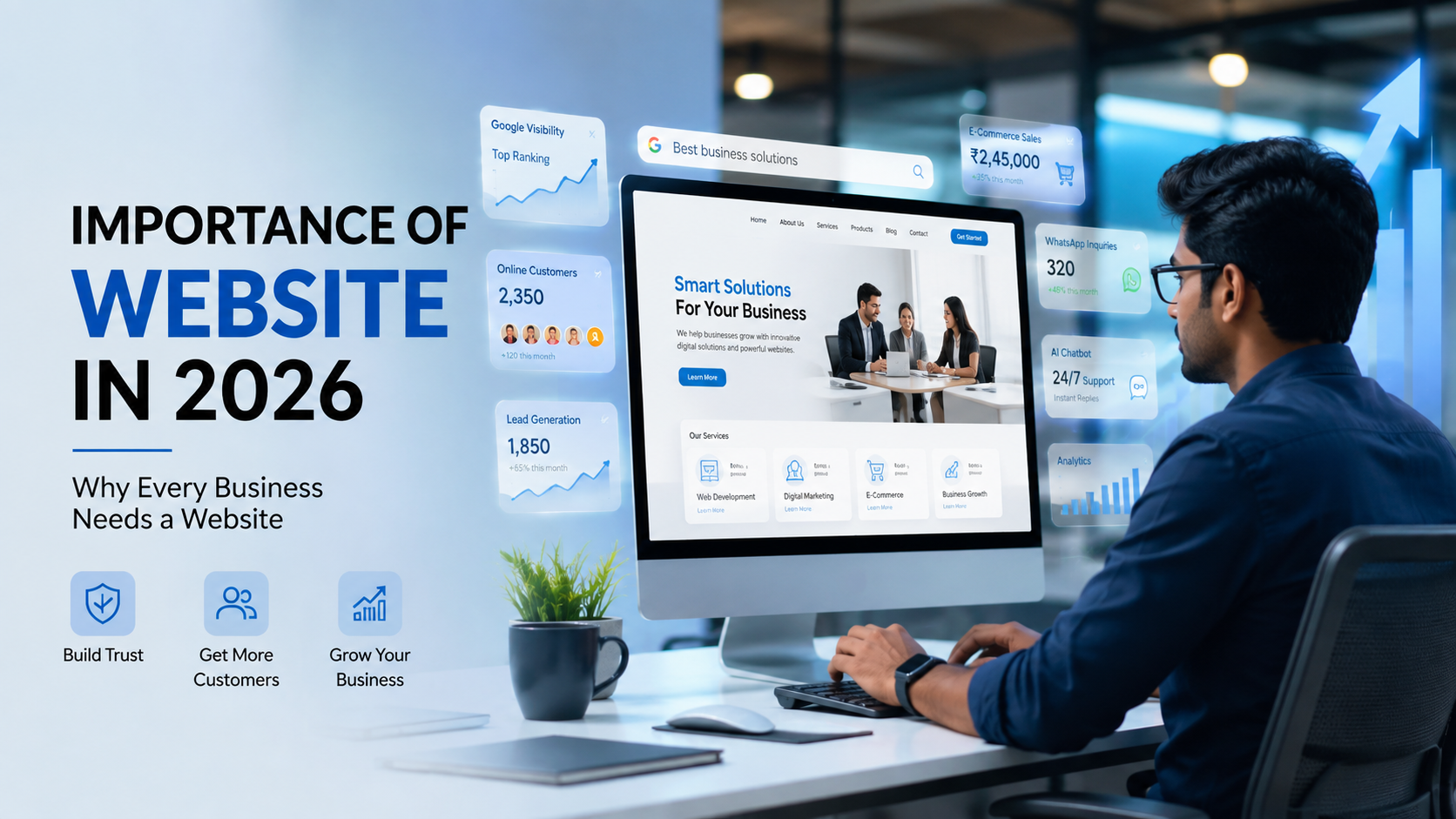
The way customers discover and evaluate businesses has changed dramatically. People now search online before visiting a store, contacting a service provider, making a purchase, or even deciding whether a company is trustworthy.
That is why the importance of a website in 2026 is greater than ever.
Whether you run a small local business, startup, professional service, manufacturing company, retail store, educational institution, or growing enterprise, having a professional website gives your business a permanent digital presence.
Social media can help you reach people, but your website gives you something you don't fully control on social platforms: your own digital home.
What Is the Importance of a Website in 2026?
A business website is much more than a collection of pages containing your company information.
A modern website can work as:
- Your digital storefront
- Your company's online identity
- A lead-generation system
- A product or service catalogue
- A sales channel
- A customer-support resource
- A trust-building platform
- A search-engine visibility channel
- An information hub
- An automation platform
In 2026, customers expect businesses to be discoverable online. When someone searches for your company and cannot find an official website, it can create uncertainty about your business.
A professional website helps answer the customer's most important questions quickly:
Who are you? What do you offer? Where are you located? Can I trust you? How can I contact you?
1. A Website Builds Business Credibility
Trust is one of the biggest reasons businesses need a website.
Before purchasing a product or service, customers often research the company online. They may look for your services, portfolio, customer reviews, contact information, business address, certifications, case studies, and other credibility signals.
A professionally designed website gives customers a central place to verify your business.
Your website can showcase:
- Company information
- Products and services
- Customer testimonials
- Portfolio
- Case studies
- Certifications
- Awards
- Business locations
- Contact information
- Frequently asked questions
A strong website doesn't simply tell customers that your business is legitimate — it demonstrates professionalism.
2. Your Website Works 24/7
One of the biggest advantages of a website is availability.
Your physical office or store may operate for 8–12 hours a day. Your sales team may not be available at midnight. Your social media team may not respond immediately.
Your website, however, can remain available 24 hours a day, 7 days a week.
Customers can visit your website at any time to:
- Learn about your business
- View products
- Check services
- Submit enquiries
- Download documents
- Request quotations
- Book appointments
- Contact your team
- Make purchases
This makes your website an always-on business asset.
3. A Website Helps You Generate Leads
A website can become one of your most important lead-generation channels.
Instead of simply displaying information, you can design your website to encourage visitors to take action.
For example:
Visitor → Service Page → Enquiry Form → Lead → Sales Team → Customer
You can add:
- Contact forms
- WhatsApp buttons
- Call buttons
- Quote request forms
- Booking forms
- Product enquiry forms
- Newsletter subscriptions
- Downloadable resources
- Chatbots
- CRM integrations
When connected to a CRM, website enquiries can automatically become leads for your sales team.
This turns your website from a digital brochure into a sales system.
4. Your Website Helps Customers Find You on Google
Search engines remain an important way for customers to discover businesses.
Suppose someone searches:
"Best website development company in Chennai"
or:
"Digital marketing company near me"
or:
"GST API provider in India"
A well-optimized website gives your business an opportunity to appear for relevant searches.
This is where SEO (Search Engine Optimization) becomes important.
A good SEO strategy can include:
- Keyword research
- Search-friendly content
- Technical SEO
- Fast page speed
- Mobile optimization
- Internal linking
- Structured content
- Local SEO
- Helpful blog articles
- Optimized service pages
The result can be a steady stream of relevant visitors without depending entirely on paid advertising.
5. Social Media Is Not a Replacement for a Website
Social media is extremely valuable for marketing, but it should not be your only digital presence.
Your Instagram, Facebook, LinkedIn, or other social profiles exist on platforms controlled by third parties.
Algorithms can change.
Reach can change.
Advertising costs can change.
Platform policies can change.
Your website gives you much greater control over your business information, branding, content, customer journey, and integrations.
A strong digital strategy is therefore not:
Website OR Social Media
It is:
Website + SEO + Social Media + Content + Advertising + Automation
Your social media channels can bring visitors to your website, while your website can convert those visitors into leads and customers.
6. A Website Strengthens Your Brand
Your website is one of the most important places to establish your brand identity.
You control:
- Logo placement
- Brand colours
- Typography
- Images
- Messaging
- Product presentation
- User experience
- Content structure
This allows you to create a consistent brand experience.
For example, a professional company can use its website to communicate:
Who we are → What we do → Why choose us → Our results → How to contact us
That consistency helps customers remember your business.
7. Websites Help Small Businesses Compete
You don't need to be a large corporation to benefit from a professional website.
In fact, websites can be particularly valuable for small and local businesses.
A small business can use its website to compete for searches against larger companies by focusing on specific products, services, locations, and customer needs.
For example:
- Restaurant in Ariyalur
- Web development company in Trichy
- Textile manufacturer in Tiruppur
- Digital marketing agency in Madurai
- Internet service provider in Tamil Nadu
- Accounting services in Chennai
A well-optimized local website can help businesses become more discoverable to customers searching for their services.
8. Your Website Can Increase Sales
A website can directly contribute to revenue.
For e-commerce businesses, customers can discover products, compare options, and purchase online.
For service businesses, the website can educate visitors and convert them into enquiries.
For B2B businesses, the website can generate qualified leads.
For example:
SEO → Website Visitor → Product Page → Enquiry → Sales Call → Purchase
or:
Social Media → Landing Page → Lead Form → CRM → Sales Team → Customer
A website therefore becomes an important part of the entire customer acquisition process.
9. Websites Can Be Connected With Business Automation
Modern websites are no longer isolated systems.
They can connect with your existing business tools.
For example:
Website + CRM
Website enquiries can automatically enter your CRM.
Website + WhatsApp
Visitors can start a WhatsApp conversation directly from your website.
Website + Payment Gateway
Customers can pay online.
Website + Email
Automated confirmation and follow-up emails can be sent.
Website + AI
AI chatbots can answer frequently asked questions and guide visitors.
Website + Analytics
You can understand how visitors interact with your website.
This makes a website an important component of a modern digital business infrastructure.
10. AI Makes Websites More Powerful in 2026
Artificial intelligence is changing how businesses build and operate websites.
Modern websites can incorporate AI-powered features such as:
- AI chat assistants
- Automated customer support
- Product recommendations
- Personalized content
- AI-powered search
- Lead qualification
- Automated FAQ systems
- Content generation
- Customer enquiry classification
Instead of simply displaying information, websites can increasingly become interactive digital assistants for businesses.
This is one reason the role of a website is becoming more important rather than less important.
11. Mobile-Friendly Websites Are Essential
A large portion of internet activity happens through smartphones.
That means your website must work properly on:
- Smartphones
- Tablets
- Laptops
- Desktop computers
A mobile-friendly website should have:
- Easy navigation
- Readable text
- Fast loading
- Responsive layouts
- Large touch-friendly buttons
- Simple enquiry forms
- Optimized images
A website that looks good only on desktop computers can lose potential customers.
12. Website Speed Matters
Customers don't want to wait for a slow website.
Website performance affects user experience and can influence how effectively visitors engage with your pages.
Important areas include:
- Image optimization
- Efficient code
- Good hosting
- Browser caching
- Content delivery networks
- Optimized databases
- Reduced unnecessary scripts
A fast website makes it easier for visitors to browse your services and take action.
13. A Website Gives You Valuable Customer Data
With appropriate analytics and privacy practices, a website can help you understand customer behaviour.
You can learn:
- Which pages receive the most visits
- Which products attract attention
- Where visitors come from
- Which campaigns generate traffic
- Which pages generate enquiries
- What customers search for
- Where visitors leave your website
These insights can help you improve your marketing and sales strategy.
Instead of guessing what customers want, you can make decisions based on measurable behaviour.
14. A Website Supports Local SEO
For local businesses, a website can support visibility in location-based searches.
A local business can create useful pages and content around:
- City
- District
- Service area
- Products
- Services
- Customer problems
- Frequently asked questions
For example, a Tamil Nadu-based business could create useful content targeting relevant searches across cities such as Chennai, Coimbatore, Madurai, Trichy, Salem, Tiruppur, and other service areas where it actually operates.
The key is to create genuinely useful local content rather than simply repeating city names.
15. Your Website Can Reduce Customer Support Work
Many customers ask the same questions repeatedly.
A well-structured website can answer those questions before customers contact your team.
You can publish:
- FAQs
- Pricing information
- Documentation
- Product specifications
- Tutorials
- Guides
- Policies
- Installation instructions
- Support articles
This can reduce repetitive enquiries and allow your team to focus on more important customer requirements.
16. A Website Helps Build Long-Term Digital Assets
Paid advertising can produce traffic while you spend money.
A website combined with SEO and valuable content can build a long-term digital asset.
For example:
Blog Article → Google Search → Visitor → Website → Lead → Customer
A useful article published today can potentially continue attracting visitors months or years later.
This is one of the major reasons businesses should think about their website as an investment rather than simply an expense.
17. What Should a Business Website Have in 2026?
A professional business website should generally include:
Essential Pages
- Home
- About Us
- Products / Services
- Contact
- Privacy Policy
- Terms & Conditions
Trust Elements
- Customer testimonials
- Reviews
- Portfolio
- Case studies
- Certifications
- Client logos where permitted
Conversion Elements
- Contact forms
- WhatsApp integration
- Call buttons
- Quote requests
- Booking options
- Clear calls-to-action
SEO Elements
- Search-friendly page titles
- Meta descriptions
- Proper headings
- Internal links
- Optimized images
- Useful content
- Mobile-friendly design
- Fast loading
Modern Features
- AI chatbot
- CRM integration
- Online payments
- Analytics
- Marketing automation
- Customer portals
The exact features should depend on the type and size of your business.
18. How Much Does a Business Website Cost?
The cost of a website depends on its purpose and complexity.
A basic business website may require only a few pages.
A larger website may include:
- E-commerce
- Customer accounts
- CRM integration
- Payment gateways
- Booking systems
- APIs
- Dashboards
- Automation
- AI features
- Custom software
Therefore, businesses should not select a website purely based on the cheapest price.
Instead, consider:
Design + Performance + Security + SEO + Scalability + Business Goals
A website should ultimately help the business generate more visibility, enquiries, customers, or revenue.
19. Website vs Social Media: Which Is Better?
The answer is not one or the other.
They serve different purposes.
| WebsiteSocial Media | |
| You control the platform | Platform is controlled by a third party |
| Strong for SEO | Strong for engagement |
| Great for detailed information | Great for quick content |
| Strong for lead generation | Strong for audience building |
| Supports business automation | Strong for community |
| Builds a permanent digital hub | Helps distribute content |
The strongest strategy is to use both.
Social media can attract attention.
Your website can provide information and convert that attention into business.
20. Why 2026 Is the Right Time to Build Your Website
Digital competition is increasing across almost every industry.
Customers are becoming more comfortable researching businesses online before contacting them.
At the same time, technologies such as AI, automation, online payments, analytics, CRM systems, and digital marketing are making websites more powerful.
Businesses that build a strong digital foundation now can create an advantage for the years ahead.
Your competitors are not only competing on price anymore.
They are competing on:
Visibility + Trust + Experience + Speed + Convenience + Service
Your website connects many of these elements together.
Conclusion
The importance of a website in 2026 goes far beyond simply having an online presence.
A professional website can help your business:
- Build credibility
- Reach new customers
- Generate leads
- Improve Google visibility
- Strengthen your brand
- Increase sales
- Automate business processes
- Provide customer support
- Collect useful business insights
- Compete in local and global markets
Whether you're a freelancer, local business owner, startup, retailer, manufacturer, service provider, or established company, your website can become one of your most valuable digital assets.
Social media may bring people to your business, but your website gives them a place to learn, trust, and take action.
In 2026, having a professional website isn't simply about keeping up with technology.
It's about building a stronger foundation for your business's future.