
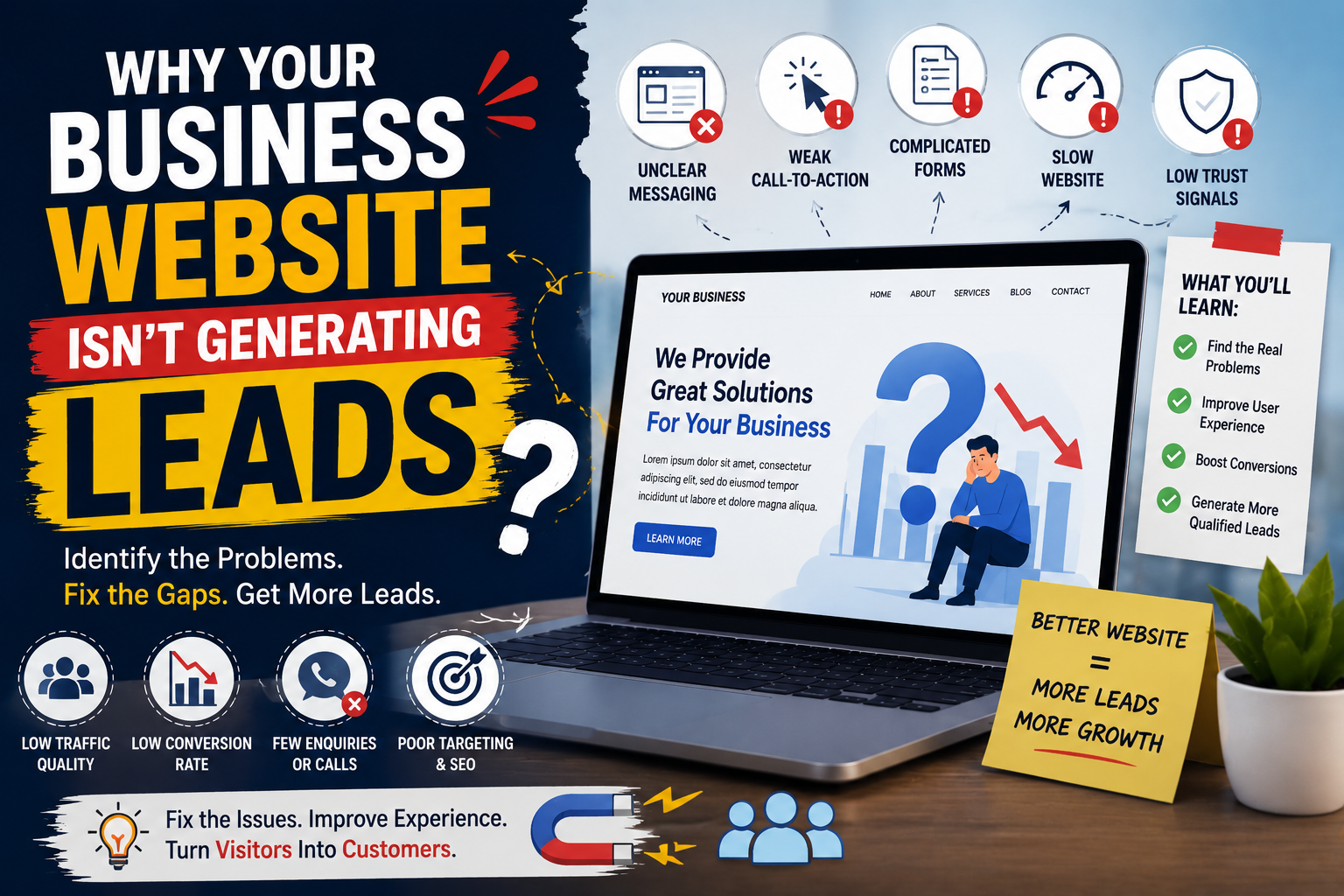
Having a business website does not automatically mean that customers will contact you.
You may have a professional design, several pages, good products, and regular website traffic, but still receive very few enquiries.
This can be frustrating for businesses that have invested time and money into their online presence.
The problem is often not the website itself.
It may be the way the website is designed to attract, engage, and convert visitors.
A successful lead-generation website needs to answer customer questions, build trust, provide clear next steps, and make it easy for visitors to contact the business.
A typical journey should look like:
Visitor → Website → Information → Trust → Call-to-Action → Enquiry → Lead → Customer
If visitors are dropping out somewhere along this journey, your website may not be converting effectively.
What Does It Mean When a Website Isn't Generating Leads?
A website can receive hundreds or thousands of visitors without generating meaningful business enquiries.
For example:
5,000 Website Visitors → 20 Enquiries → 3 Qualified Leads
This could indicate that the website is attracting visitors but not converting enough of them.
Common symptoms include:
- High website traffic but few enquiries
- Many visitors leaving quickly
- Very few form submissions
- Low WhatsApp clicks
- Few phone calls
- Low landing-page conversions
- Visitors viewing pages but taking no action
- Poor performance from paid campaigns
- Low-quality leads
- Customers asking basic questions that the website should answer
Understanding where the problem occurs is the first step toward improving lead generation.
1. Your Website Doesn't Clearly Explain What You Offer
One of the biggest reasons websites fail to generate leads is unclear messaging.
When visitors land on your website, they should quickly understand:
Who are you? What do you offer? Who do you help? Why should they choose you?
If the homepage contains vague statements without explaining the actual value of the business, visitors may leave.
For example:
Instead of:
"We Deliver Innovative Solutions for Modern Businesses."
Use something more specific:
"We Help Small Businesses Generate More Leads Through SEO and Digital Marketing."
Clear messaging helps visitors understand your offering without making them search through multiple pages.
2. Your Website Doesn't Have Clear Calls-to-Action
A visitor may be interested in your service but still leave because they don't know what to do next.
Your website should clearly guide visitors toward an action.
Useful calls-to-action include:
- Get a Quote
- Contact Us
- Request a Demo
- Book an Appointment
- Get Started
- Request Pricing
- Talk to an Expert
- Call Now
- WhatsApp Us
- Download Brochure
For example:
Service Page → Request a Quote → Enquiry Form
A website should not force visitors to figure out the next step themselves.
3. Your Enquiry Forms Are Too Complicated
Long forms can discourage potential customers from submitting their information.
If a visitor has to complete 10 or 15 fields before making a simple enquiry, they may simply leave.
A basic lead form may only need:
- Name
- Phone number
- Service required
- Requirement
For example:
Name → Phone → Requirement → Submit
You can collect additional information later during the sales process.
The easier it is to contact your business, the more opportunities you may have to capture potential leads.
4. Your Website Doesn't Build Enough Trust
Customers may be interested in your products or services but hesitate to contact you if they don't feel confident about your business.
Your website should provide evidence that your company is legitimate and capable.
Useful trust signals include:
- Customer testimonials
- Reviews
- Case studies
- Portfolio
- Client logos where permitted
- Certifications
- Awards
- Company information
- Business address
- Contact information
For example:
Our Services → Our Work → Customer Results → Testimonials → Contact
Trust should be built throughout the customer's journey.
5. Your Website Attracts the Wrong Visitors
More website traffic does not necessarily mean more leads.
Your website may be receiving visitors who are not interested in your products or services.
For example:
10,000 Visitors → 50 Relevant Visitors → 5 Enquiries
The problem may be your targeting rather than your website design.
Businesses should focus on attracting people who are actually searching for their products, services, or solutions.
This can be improved through:
- Relevant keywords
- Targeted advertising
- Industry-specific content
- Location-based content
- Service-specific landing pages
- Clear audience targeting
The goal is to attract relevant traffic, not simply more traffic.
6. Your Website Is Not Optimized for Search Engines
Potential customers cannot become leads if they cannot find your website.
Search Engine Optimization helps your business appear for relevant searches.
For example:
"Web development company in Chennai"
"Digital marketing agency in Coimbatore"
"Accounting services in Chennai"
"Business software company in India"
Your website can improve its search visibility through:
- Keyword research
- Service pages
- Helpful blog content
- Local SEO
- Internal linking
- Search-friendly page titles
- Meta descriptions
- Optimized images
- Technical SEO
- Fast page performance
SEO should focus on attracting people who have a genuine interest in what your business offers.
7. Your Website Is Too Slow
A slow website can create a poor first impression.
Visitors may leave before your website has a chance to explain your products or services.
Common causes of slow websites include:
- Large images
- Poor hosting
- Unoptimized code
- Too many scripts
- Large videos
- Unnecessary plugins
- Poor database performance
- Lack of caching
A business website should be optimized for both desktop and mobile performance.
A simple journey should be:
Click → Page Loads Quickly → Information Appears → Customer Takes Action
The longer customers have to wait, the greater the opportunity for them to leave.
8. Your Website Is Difficult to Use on Mobile
Many potential customers access business websites using smartphones.
If your website is difficult to use on a mobile device, you may lose potential leads.
A mobile-friendly website should have:
- Responsive design
- Readable text
- Simple navigation
- Large touch-friendly buttons
- Easy forms
- Click-to-call options
- WhatsApp integration
- Optimized images
Customers should be able to browse your website and contact your business without needing to switch to a desktop computer.
9. Your Website Doesn't Answer Customer Questions
Potential customers often have questions before contacting a business.
If your website doesn't provide the information they need, they may look elsewhere.
Common questions include:
- How much does it cost?
- What services do you provide?
- Where do you operate?
- How long does the process take?
- Do you provide support?
- What payment methods do you accept?
- What makes your business different?
- Do you have previous experience?
- What happens after I submit an enquiry?
- How can I contact you?
You can answer these questions through:
FAQs + Service Pages + Blog Articles + Guides + Case Studies
Helpful content can remove uncertainty and encourage customers to take the next step.
10. Your Website Doesn't Have Dedicated Landing Pages
Sending every visitor to the homepage can make it harder to convert campaign traffic.
A dedicated landing page can focus on one specific product, service, audience, or campaign.
For example:
Google Ad → Website Development Landing Page → Request Quote
or:
LinkedIn Ad → B2B Software Landing Page → Book Demo
A strong landing page can include:
- Clear headline
- Customer problem
- Solution
- Benefits
- Features
- Testimonials
- Case studies
- FAQ
- CTA
- Lead form
The page should focus on one primary goal.
11. Your Website Doesn't Make It Easy to Contact You
Some websites hide their contact information deep inside the website.
Customers should not have to search for your phone number or email address.
Make it easy to contact your business through:
- Phone
- Contact forms
- Live chat
- Booking systems
- Chatbots
For example:
Website → WhatsApp → Enquiry → Sales Team
Reducing the number of steps can make the customer journey easier.
12. Your Website Doesn't Show Why Customers Should Choose You
Customers usually compare multiple businesses before making a decision.
Your website should clearly communicate what makes your company different.
You can highlight:
- Experience
- Expertise
- Customer results
- Product quality
- Service coverage
- Support
- Certifications
- Technology
- Industry knowledge
- Customer reviews
For example:
Customer Problem → Your Solution → Your Advantage → Customer Result
Your website should help customers understand not only what you do, but also why they should choose you.
13. Your Content Talks Too Much About Your Business
A common website mistake is focusing entirely on the company.
Customers are more interested in how your products or services can help them.
Instead of only saying:
"We have 15 years of experience."
Explain:
"Our 15 years of experience helps businesses reduce project delays and improve operational efficiency."
The focus should move from:
"We are..."
to:
"We can help you..."
Customer-focused content can make your website more relevant and engaging.
14. Your Website Doesn't Have Enough Social Proof
Customers often want to know whether other people have successfully used your products or services.
Social proof can include:
- Customer reviews
- Testimonials
- Case studies
- Project results
- Ratings
- Client stories
- Before-and-after examples
- Portfolio work
For example:
Customer Problem → Your Service → Result → Customer Testimonial
Real examples can help potential customers feel more confident about contacting your business.
15. You Are Not Tracking Conversions
Without tracking, it is difficult to know why your website isn't generating leads.
Analytics can help you understand:
- Website traffic
- Traffic sources
- Most visited pages
- CTA clicks
- Form submissions
- WhatsApp clicks
- Phone calls
- Landing page performance
- Conversion rates
- Customer journeys
For example:
10,000 Visitors → 200 Form Views → 40 Form Submissions → 10 Qualified Leads
This data helps identify where visitors are dropping out.
How to Find Where Your Website Is Losing Leads
A simple way to analyze your customer journey is:
Traffic
↓
Landing Page
↓
Service / Product Page
↓
Trust & Information
↓
Call-to-Action
↓
Form / WhatsApp / Call
↓
Lead
If traffic is high but landing-page engagement is low, the page may need improvement.
If visitors read your pages but don't click the CTA, the offer or messaging may need improvement.
If visitors click the CTA but don't submit the form, the form may be too complicated.
This approach helps businesses identify the actual problem instead of changing the entire website without understanding why it is underperforming.
How to Improve a Website That Isn't Generating Leads
Businesses can start with a simple improvement process:
Step 1: Check Your Traffic
Understand where visitors are coming from.
Google → Social Media → Advertising → Direct Traffic → Website
Step 2: Review Your Homepage
Ask whether a new visitor can understand your business within a few seconds.
Step 3: Check Your Service Pages
Make sure every important service has clear information and a strong CTA.
Step 4: Simplify Your Forms
Remove unnecessary fields.
Step 5: Add Trust Signals
Show reviews, testimonials, case studies, and results.
Step 6: Improve Mobile Experience
Test your website on different smartphones.
Step 7: Improve Page Speed
Optimize images, scripts, hosting, and other performance factors.
Step 8: Track Conversions
Measure forms, calls, WhatsApp clicks, bookings, and other lead actions.
Website Traffic vs Website Leads
A common mistake is measuring website success only by traffic.
Consider:
Website A
10,000 visitors → 50 leads
Website B
3,000 visitors → 150 leads
Website B receives less traffic but generates more leads.
This shows why conversion quality matters more than traffic volume alone.
The objective should be:
Relevant Visitors → Engaged Visitors → Qualified Leads → Customers
When Should You Redesign Your Website?
Your website may need a redesign or major improvement if:
- It receives traffic but few enquiries
- It is difficult to use on mobile
- Pages load slowly
- Navigation is confusing
- Information is outdated
- CTAs are missing
- Forms are complicated
- Customers cannot find contact information
- The website looks outdated
- Analytics show poor engagement
A redesign should not focus only on appearance.
It should focus on:
User Experience + Content + Performance + SEO + Conversion + Business Goals
A Better Website Lead Generation Journey
A strong lead-generation website can create a journey like:
Google Search
↓
Relevant Landing Page
↓
Clear Customer Problem
↓
Your Solution
↓
Benefits & Results
↓
Testimonials
↓
Clear CTA
↓
Simple Form / WhatsApp / Call
↓
CRM
↓
Sales Follow-up
↓
Customer
Every stage should make the next step easy.
Conclusion
A website can receive plenty of visitors and still fail to generate leads.
The problem may be unclear messaging, complicated forms, weak calls-to-action, poor SEO, slow performance, limited trust signals, or a difficult customer journey.
A successful business website should help customers:
- Find your business
- Understand your offering
- See the value you provide
- Trust your company
- Find answers
- Contact you easily
- Submit an enquiry
- Receive a response
- Move through the sales process
The ideal journey is:
Attract → Engage → Build Trust → Convert → Follow Up → Sell
If your website is not generating enough leads, don't immediately assume you need a completely new website.
First, identify where visitors are leaving and why they are not taking action.
Then improve the specific areas that are creating friction.
Your website doesn't need more visitors alone. It needs to turn the right visitors into real business opportunities.