
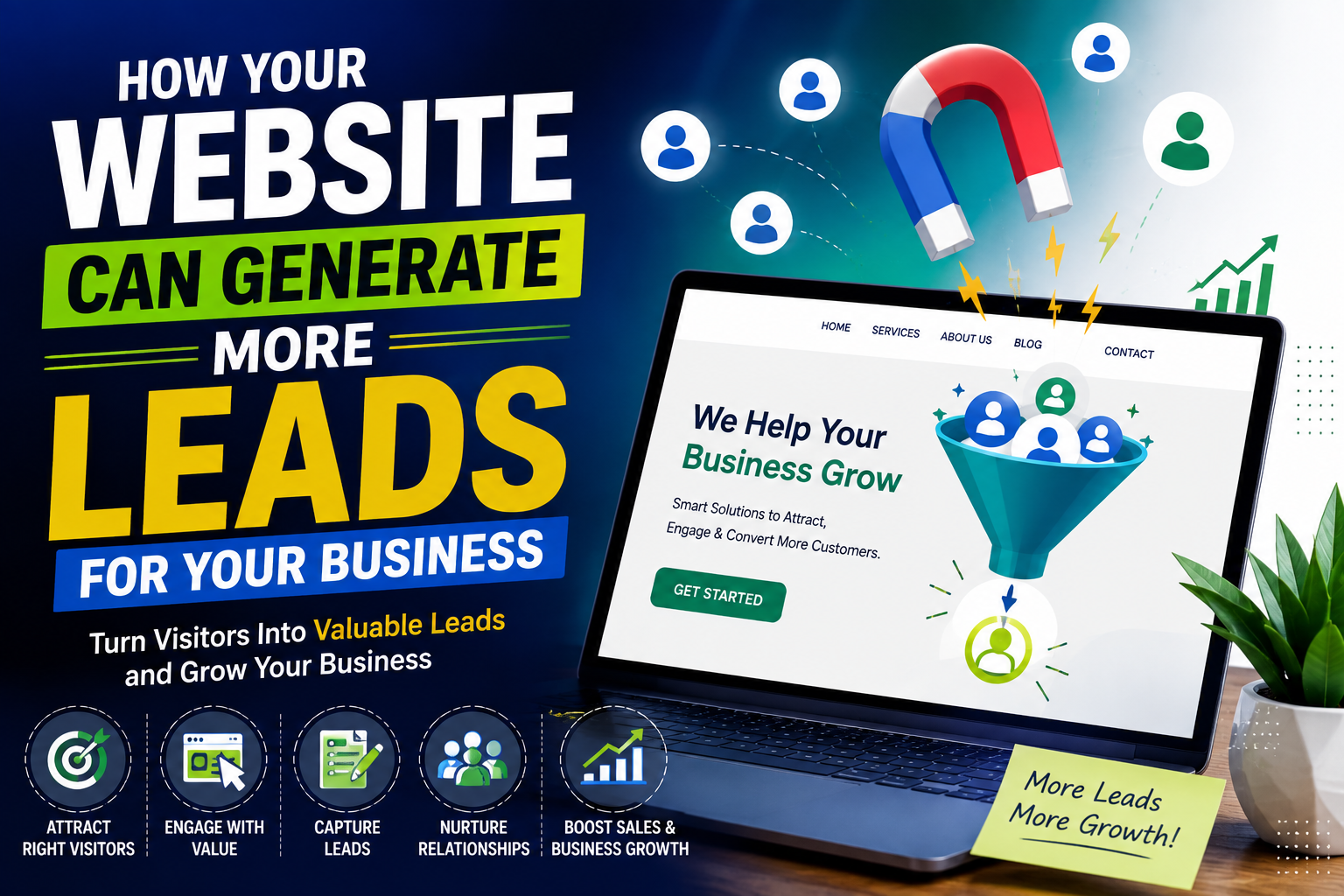
The way customers discover and evaluate businesses has changed dramatically. People often search online before contacting a service provider, requesting a quotation, making a purchase, or deciding whether a company is trustworthy.
That is why your website can play an important role in generating leads for your business.
A website should not simply contain information about your company.
It can work as:
- Your digital storefront
- A lead-generation channel
- A product or service catalogue
- A sales-support tool
- A customer information hub
- A trust-building platform
- An SEO channel
- A communication platform
- An automation system
- A long-term digital asset
A simple customer journey can look like:
Google Search → Website → Service Page → Enquiry → Sales Team → Customer
The goal is to make this journey as simple as possible.
What Is Website Lead Generation?
Website lead generation is the process of attracting potential customers to your website and encouraging them to take an action that can begin a business conversation.
For example:
Visitor → Website → Product / Service → Call-to-Action → Form → Lead → Follow-up → Customer
Depending on your business, a lead could be someone who:
- Submits an enquiry
- Requests a quotation
- Books an appointment
- Calls your business
- Starts a WhatsApp conversation
- Requests a product demo
- Downloads a brochure
- Signs up for a consultation
- Creates an account
- Makes a purchase
Your website should make these actions easy to complete.
1. Create a Clear Value Proposition
When someone visits your website, they should quickly understand what your business does and how you can help them.
Your homepage should answer:
What do you offer? Who do you help? What problem do you solve? Why should customers choose you?
For example, instead of:
"We Deliver Innovative Business Solutions."
A more specific message could be:
"We Help Small Businesses Generate More Leads Through SEO and Digital Marketing."
Clear messaging helps visitors understand your offering without having to search through several pages.
A strong value proposition can move the customer from:
Visitor → Understanding → Interest → Action
2. Use Clear Calls-to-Action
Visitors may be interested in your service but still leave if they don't know what to do next.
Your website should clearly guide visitors toward an action.
Useful calls-to-action include:
- Get a Quote
- Contact Us
- Request a Demo
- Book an Appointment
- Get Started
- Request Pricing
- Talk to an Expert
- Call Now
- WhatsApp Us
- Download Brochure
For example:
Service Page → Request a Quote → Enquiry Form
The CTA should be visible and relevant to the page the customer is viewing.
3. Add Simple Lead Capture Forms
Contact forms are one of the easiest ways to collect website leads.
However, a complicated form can discourage visitors from completing it.
A basic form may only require:
- Name
- Phone number
- Service required
- Requirement details
For example:
Name → Phone → Requirement → Submit
You can collect additional information during the sales process.
The objective is to remove unnecessary steps and make it easy for interested customers to contact you.
4. Create Dedicated Landing Pages
Businesses often send all website visitors to the homepage.
For marketing campaigns, dedicated landing pages can be more effective because they focus on a specific product, service, or offer.
For example:
Google Search → Web Development Landing Page → Request Quote
or:
LinkedIn Campaign → Business Software Landing Page → Book Demo
A landing page can include:
- Clear headline
- Customer problem
- Your solution
- Benefits
- Features
- Customer results
- Testimonials
- FAQs
- Call-to-action
- Lead form
A focused landing page helps visitors understand exactly what they are being offered.
5. Make Your Website Search-Friendly
Before your website can generate leads, potential customers need to find it.
Search Engine Optimization can help your business appear for relevant searches.
For example:
"Website development company in Chennai"
"Digital marketing agency in Madurai"
"Accounting services in Chennai"
"Solar company in Tamil Nadu"
Your website can improve its search visibility through:
- Relevant keywords
- Service pages
- Product pages
- Blog articles
- Local SEO
- Search-friendly titles
- Meta descriptions
- Internal links
- Optimized images
- Useful content
The objective is not simply to get more visitors.
It is to attract people who are genuinely interested in what you offer.
6. Publish Content That Answers Customer Questions
Customers often research before making a decision.
They may search for:
"How much does it cost?"
"Which service is right for my business?"
"How does this product work?"
"What should I check before buying?"
Your website can answer these questions through:
- Blog articles
- FAQs
- Guides
- Tutorials
- Case studies
- Product comparisons
- Industry resources
- Checklists
- Downloadable documents
- Videos
For example:
Google Search → Helpful Blog → Service Page → Enquiry
Useful content can bring potential customers to your website and introduce them to your business.
7. Build Trust With Customer Proof
Customers may not submit an enquiry if they are unsure whether your business is reliable.
Your website can demonstrate credibility through:
- Customer testimonials
- Reviews
- Case studies
- Portfolio
- Certifications
- Awards
- Client logos where permitted
- Previous projects
- Business information
- Contact details
For example:
Service → Previous Work → Customer Result → Testimonial → Enquiry
A strong website does not simply say that your business is trustworthy.
It provides evidence that helps customers feel confident.
8. Add WhatsApp and Direct Communication
Some customers prefer starting a conversation rather than filling out a form.
Adding WhatsApp and other direct communication options can make your website easier to use.
You can provide:
- Click-to-call
- Live chat
- Chatbots
- Contact forms
- Appointment booking
For example:
Website → WhatsApp → Customer Question → Sales Team
Reducing the number of steps between the visitor and your business can create more opportunities for enquiries.
9. Make Your Website Mobile-Friendly
A large portion of internet activity happens through smartphones.
Your website should work properly across:
- Smartphones
- Tablets
- Laptops
- Desktop computers
A mobile-friendly website should have:
- Easy navigation
- Readable text
- Fast loading
- Responsive layouts
- Touch-friendly buttons
- Simple forms
- Optimized images
- Easy contact options
A potential customer should be able to discover your service and contact your business without needing to switch to a desktop.
10. Improve Website Speed
Customers don't want to wait for a slow website.
If a page takes too long to load, visitors may leave before they even see your offer.
Website performance can be improved through:
- Image optimization
- Reliable hosting
- Browser caching
- Efficient code
- Reduced unnecessary scripts
- Database optimization
- Content delivery networks
- Optimized website assets
A simple customer journey should be:
Click → Fast Page Load → Information → CTA → Enquiry
Website speed is therefore part of the overall lead-generation experience.
11. Connect Your Website With Your CRM
Generating a lead is only the beginning.
Your sales team also needs to manage and follow up with that lead.
A CRM integration can connect your website enquiries with your sales process.
For example:
Website Form → CRM → Lead Assignment → Sales Follow-up → Customer
A website can automatically send enquiry information into your CRM.
This can help businesses:
- Create new leads
- Assign leads to sales representatives
- Record customer information
- Track lead status
- Schedule follow-ups
- Monitor conversions
- Reduce manual data entry
This makes the website part of the wider sales system.
12. Use Analytics to Measure Leads
Website traffic alone does not tell you whether your website is generating business.
Analytics can help you understand:
- Number of visitors
- Traffic sources
- Most visited pages
- CTA clicks
- Form submissions
- WhatsApp clicks
- Phone calls
- Landing-page performance
- Conversion rates
- Campaign performance
For example:
10,000 Visitors → 500 Enquiries → 100 Qualified Leads → 20 Customers
This information helps businesses understand which marketing activities and website pages are producing results.
13. Use AI to Support Lead Generation
AI is making business websites more interactive.
Modern websites can include AI-powered features such as:
- AI chat assistants
- Automated customer support
- Lead qualification
- Product recommendations
- Personalized content
- AI-powered search
- Automated FAQ systems
- Customer enquiry classification
- Appointment assistance
For example:
Visitor → AI Assistant → Questions Answered → Lead Qualified → Sales Team
AI does not necessarily replace your sales team.
Instead, it can help answer common questions and identify potential customers before passing them to your team.
14. Offer Something Valuable
Some visitors may be interested in your business but may not be ready to contact your sales team immediately.
You can encourage them to take a smaller first step.
For example:
- Free consultation
- Product demo
- Free assessment
- Free audit
- Industry guide
- Product brochure
- Downloadable checklist
- Pricing guide
For example:
Landing Page → Free Consultation → Lead Form → Sales Follow-up
The offer should be genuinely useful and relevant to the visitor.
15. Create Location-Specific Pages
Local businesses can use their websites to attract customers searching for services in specific locations.
For example:
Web Development Company in Chennai
Digital Marketing Agency in Coimbatore
Accounting Services in Trichy
Solar Company in Tamil Nadu
Location-specific pages can include:
- Services available in the area
- Service coverage
- Local customer examples
- Location-specific FAQs
- Contact information
- Local SEO content
This can help businesses become more discoverable to customers searching for nearby services.
16. Make Your Website Customer-Focused
A common mistake is creating website content that talks only about the company.
Customers want to understand how your business can help them.
Instead of focusing only on:
"We have 15 years of experience."
Explain:
"Our 15 years of experience helps businesses reduce project delays and improve efficiency."
The focus should move from:
"We are..."
to:
"We can help you..."
Customer-focused content makes your website more relevant to potential buyers.
17. Optimize the Customer Journey
Your website should guide customers naturally from discovery to enquiry.
A strong journey can look like:
Search
↓
Website
↓
Service / Product Page
↓
Benefits
↓
Trust Signals
↓
CTA
↓
Form / WhatsApp / Call
↓
CRM
↓
Sales Follow-up
↓
Customer
Every stage should make the next step easier.
If visitors are dropping out at a particular stage, that part of the journey may need improvement.
18. Follow Up With Website Leads Quickly
A website lead is only valuable if your business follows up.
When someone submits an enquiry, your sales team should have a process for responding.
For example:
Website Enquiry → CRM Notification → Sales Representative → Customer Conversation → Follow-up → Conversion
Automated notifications can help sales teams know when a new enquiry arrives.
Customers can also receive confirmation messages after submitting a form.
This reduces the chance of valuable enquiries being missed.
Website Traffic vs Website Leads
More website visitors do not automatically mean more customers.
Consider:
Website A
10,000 visitors → 50 leads
Website B
3,000 visitors → 150 leads
Website B receives less traffic but generates more leads.
This shows why businesses should focus on relevant traffic and conversion, rather than traffic volume alone.
The goal should be:
Relevant Visitors → Engaged Visitors → Qualified Leads → Customers
How to Build a Lead-Generating Website
A simple lead-generation strategy can look like:
Step 1: Attract
Use:
- SEO
- Social media
- Online advertising
- Content marketing
- Local search
↓
Step 2: Inform
Provide:
- Service information
- Product details
- Benefits
- FAQs
- Useful content
↓
Step 3: Build Trust
Show:
- Testimonials
- Reviews
- Case studies
- Portfolio
- Certifications
↓
Step 4: Convert
Use:
- Clear CTAs
- Contact forms
- Calls
- Booking options
↓
Step 5: Manage
Connect leads with:
- CRM
- Sales team
- Automation
- Analytics
This turns the website into part of a complete customer acquisition system.
Why Your Website Should Be Treated as a Sales Tool
A website is no longer just an online brochure.
It can connect marketing, sales, customer service, and automation.
For example:
SEO → Website → Lead → CRM → Sales → Customer
Or:
Social Media → Landing Page → Form → CRM → Follow-up → Customer
The website becomes the central point where online attention can be converted into a business opportunity.
Conclusion
Your business website can become one of your most valuable lead-generation channels when it is designed around the customer journey.
A strong lead-generation website can help your business:
- Attract relevant visitors
- Explain your products and services
- Build trust
- Answer customer questions
- Generate enquiries
- Capture customer information
- Start conversations
- Connect leads with your CRM
- Automate repetitive tasks
- Measure marketing performance
The complete journey can be:
Attract → Inform → Build Trust → Convert → Follow Up → Customer
Whether you're a freelancer, local business owner, startup, retailer, manufacturer, service provider, or established company, your website can become more than an online presence.
It can become an important part of your sales and customer acquisition process.
In 2026, businesses should not ask only:
"How many people visit our website?"
They should also ask:
"How many of those visitors are becoming real business opportunities?"
Your website doesn't just need traffic.
It needs to turn the right visitors into leads and the right leads into customers.