
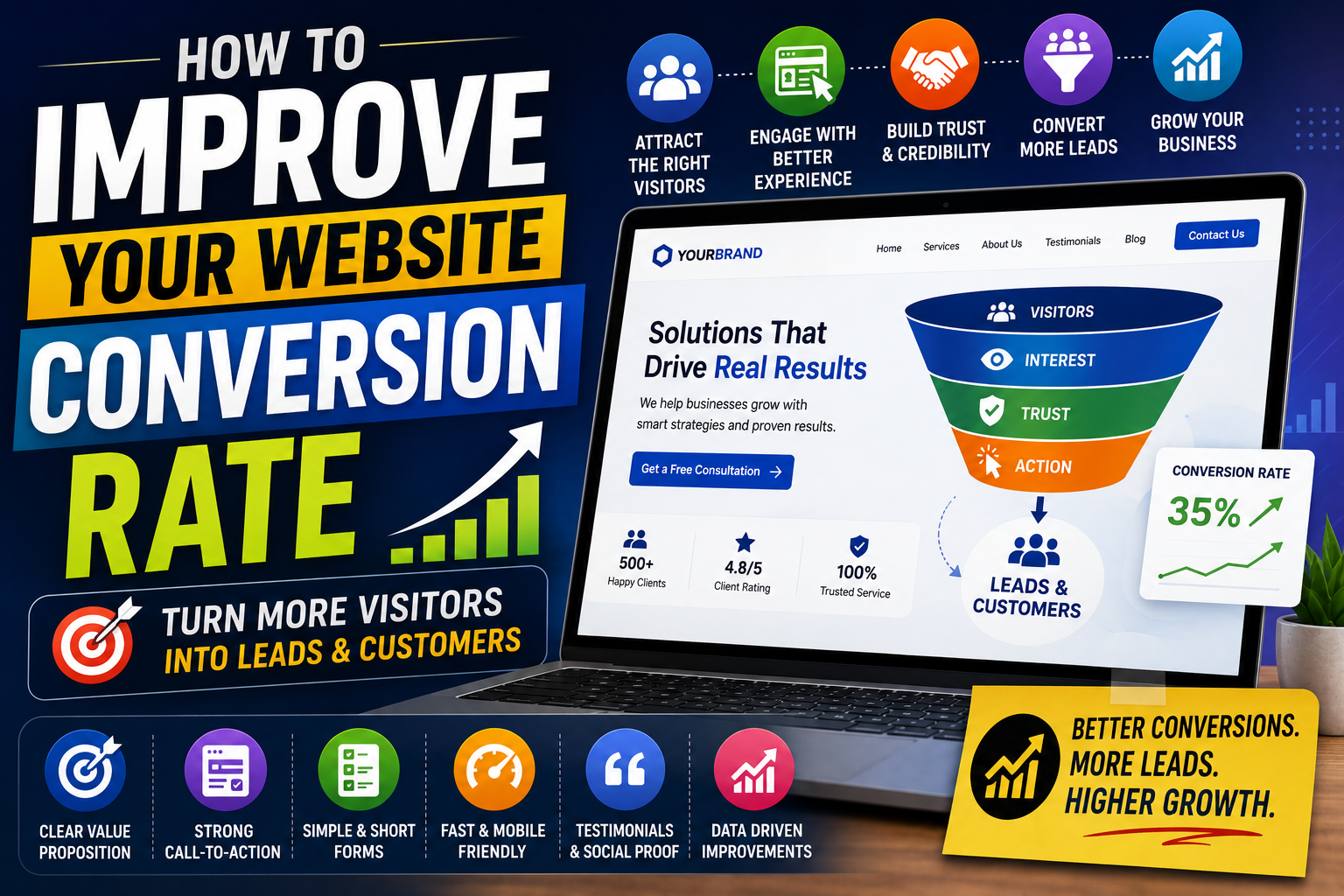
Getting people to visit your website is important, but website traffic alone does not generate business.
The real opportunity comes when visitors take meaningful actions.
They may:
- Submit an enquiry
- Request a quotation
- Book a consultation
- Call your business
- Start a WhatsApp conversation
- Request a demo
- Download a resource
- Purchase a product
This is where conversion rate optimization (CRO) becomes important.
A simple customer journey can look like:
Visitor → Website → Interest → Trust → Action → Lead → Customer
If hundreds or thousands of people visit your website but very few take action, there may be opportunities to improve the website experience.
What Is Website Conversion Rate?
Your website conversion rate represents the percentage of visitors who complete a desired action.
For example:
1,000 Visitors → 50 Enquiries
That represents a 5% conversion rate for that particular action.
The conversion you measure depends on your business.
It could be:
Visitors → Leads
or:
Visitors → Purchases
or:
Visitors → Demo Requests
The important point is to define what a successful website action means for your business.
1. Make Your Main Message Clear
When visitors land on your website, they should quickly understand:
What do you offer?
Who is it for?
How can it help them?
Avoid vague headlines that don't clearly explain your value.
Instead of:
"Innovative Solutions for Modern Businesses"
use something more specific:
"Generate More Qualified Leads With Our B2B Marketing Services."
Clear messaging helps visitors understand your offering without searching through multiple pages.
A strong homepage can follow:
Problem → Solution → Benefit → CTA
2. Use Strong Calls-to-Action
A visitor may be interested in your service but still leave because there is no obvious next step.
Your website should clearly tell visitors what to do.
Examples include:
- Get a Quote
- Book a Consultation
- Request a Demo
- Contact Us
- Get Started
- Talk to an Expert
- Request Pricing
- Call Now
- WhatsApp Us
For example:
Service Page → Learn About Service → Request a Quote
Don't make customers search for the next step.
3. Simplify Your Contact Forms
Long and complicated forms can create unnecessary friction.
If a customer only wants to request information, they may not want to provide ten different details.
Start with essential information such as:
Name → Phone → Email → Requirement → Submit
You can collect additional information later.
A shorter form can make the process easier for visitors who are ready to contact your business.
4. Create Dedicated Landing Pages
Sending every marketing visitor to your homepage isn't always the best approach.
A dedicated landing page can focus on one specific campaign or offer.
For example:
Google Ad → Service Landing Page → CTA → Enquiry
A landing page can contain:
- Clear headline
- Customer problem
- Solution
- Benefits
- Features
- Customer proof
- FAQs
- CTA
- Lead form
The page should have one clear primary objective.
5. Build Trust Before Asking for Action
Customers are less likely to convert when they are unsure about a business.
Your website can build confidence using:
- Customer testimonials
- Reviews
- Case studies
- Portfolio
- Certifications
- Awards
- Client logos where permitted
- Customer results
- Company information
For example:
Service → Case Study → Customer Result → Testimonial → Enquiry
Trust signals can reduce hesitation before a visitor contacts you.
6. Make Your Website Mobile-Friendly
A visitor shouldn't struggle to use your website on a smartphone.
Check that your website has:
- Responsive design
- Readable text
- Easy navigation
- Touch-friendly buttons
- Simple forms
- Fast loading
- Easy-to-find contact options
The mobile experience should make it simple to:
Discover → Understand → Contact
If customers have to zoom, scroll sideways, or struggle with buttons, conversions can suffer.
7. Improve Website Speed
Website performance is another important part of the customer experience.
Slow pages can interrupt the conversion journey.
Common causes include:
- Large images
- Poor hosting
- Unoptimized code
- Excessive scripts
- Large videos
- Too many plugins
- Poor caching
A better journey is:
Click → Fast Loading → Information → CTA → Conversion
Performance improvements should therefore be part of your conversion strategy.
8. Make Your Benefits Easy to Understand
Customers don't only want to know what your product or service does.
They want to know:
"How will this help me?"
For example:
Instead of:
"Our platform includes automated reporting."
Explain:
"Automated reporting helps your team reduce manual reporting work and get business insights faster."
Focus on:
Feature → Benefit → Customer Outcome
This makes your offering easier to understand.
9. Answer Customer Questions
Visitors may hesitate because they have unanswered questions.
Your website can address common concerns through FAQs, service pages, guides, and helpful content.
Questions might include:
- How does the service work?
- How much does it cost?
- What is included?
- How long does it take?
- Do you provide support?
- Where do you operate?
- What happens after I submit an enquiry?
- How can I get started?
For example:
Question → Clear Answer → Less Uncertainty → More Confidence
Helpful information can move visitors closer to taking action.
10. Improve Your Website Navigation
Visitors should be able to find important information quickly.
Keep your navigation clear and logical.
For example:
Home | About | Services | Products | Blog | Contact
For larger websites, use categories, search, filters, and internal links where appropriate.
A visitor shouldn't need to click through several unrelated pages just to find a service or contact option.
11. Add Multiple Conversion Options
Not every visitor wants to take the same action.
Some may prefer a form.
Others may want to call.
Some may prefer WhatsApp.
Give visitors relevant choices.
You can include:
Contact Form
Phone
Book an Appointment
Request a Demo
The goal isn't to overwhelm visitors with buttons.
It is to provide an appropriate way for different customers to start a conversation.
12. Use Content to Move Visitors Toward Conversion
Not every visitor is ready to buy immediately.
Some are still researching.
Helpful content can keep them engaged.
For example:
Blog → Service Page → Case Study → Contact
Useful content can include:
- Blog articles
- Guides
- Checklists
- Case studies
- FAQs
- Product comparisons
- Videos
- Industry resources
Content should help visitors move from:
Awareness → Interest → Consideration → Action
13. Make Your Website More Customer-Focused
A common website mistake is talking too much about the company.
Customers are primarily interested in their own needs.
Instead of:
"We have 15 years of experience."
Explain:
"Our experience helps businesses reduce project delays and improve efficiency."
Move the focus from:
"We are..."
to:
"We can help you..."
Customer-focused messaging can make your website more relevant.
14. Use Social Proof Throughout the Customer Journey
Don't hide all your customer proof on one testimonials page.
Relevant proof can appear throughout your website.
For example:
Homepage
Customer rating + testimonial
Service Page
Relevant case study
Product Page
Customer reviews
Landing Page
Customer results
This gives visitors evidence while they are making their decision.
15. Create a Sense of Clarity Around Pricing
Pricing can be a major source of hesitation.
Depending on your business, you can provide:
- Starting prices
- Packages
- Pricing ranges
- What's included
- Factors affecting price
- Quote request options
If your service requires a custom quotation, explain why.
For example:
"Every project is customized based on requirements, scope, and integrations. Request a quote for a tailored estimate."
Clear expectations can reduce uncertainty.
16. Use Personalization Where It Adds Value
Different visitors may have different needs.
Personalization can help present more relevant information.
For example:
Industry → Relevant Services → Relevant Case Study → Relevant CTA
A website can also personalize:
- Product recommendations
- Location-based information
- Content
- Offers
- Service suggestions
The goal is to make the visitor's experience more relevant, not simply more complicated.
17. Use AI and Automation Carefully
AI can support conversion by helping visitors find information and start conversations.
Useful applications include:
- AI chat assistants
- Lead qualification
- Automated FAQs
- Product recommendations
- Appointment assistance
- Customer enquiry routing
For example:
Visitor → AI Assistant → Question Answered → Qualified Lead → Sales Team
AI should support the customer journey rather than make it harder.
18. Track What Visitors Actually Do
You cannot improve conversion effectively if you don't measure it.
Track actions such as:
- Form submissions
- CTA clicks
- WhatsApp clicks
- Phone calls
- Demo requests
- Purchases
- Booking requests
- Landing-page performance
For example:
10,000 Visitors → 500 CTA Clicks → 150 Enquiries → 30 Qualified Leads
This helps you identify where visitors are dropping out.
19. Find Where Visitors Are Leaving
Think of your website as a funnel:
Visitors
↓
Landing Page
↓
Service / Product Page
↓
CTA
↓
Form / Call / WhatsApp
↓
Lead
If you have high traffic but very few CTA clicks, your page messaging or offer may need improvement.
If many visitors click the CTA but don't submit the form, the form may be creating friction.
Instead of changing everything at once, identify the weakest stage first.
20. Test and Improve Continuously
Conversion optimization isn't a one-time activity.
You can continuously test:
- Headlines
- CTA wording
- Button placement
- Form length
- Page layouts
- Images
- Offers
- Landing pages
- Pricing presentation
For example:
Version A → Measure
Version B → Measure
Compare → Improve
The goal is to make decisions based on customer behaviour rather than assumptions.
A Simple Website Conversion Funnel
A strong conversion journey can look like:
Traffic
↓
Relevant Landing Page
↓
Clear Value Proposition
↓
Benefits
↓
Trust Signals
↓
Customer Questions Answered
↓
CTA
↓
Simple Form / WhatsApp / Call
↓
CRM
↓
Sales Follow-up
↓
Customer
Every stage should make it easier for the visitor to move forward.
Traffic vs Conversion
More visitors do not necessarily mean more business.
Consider:
Website A
10,000 visitors → 100 leads
Website B
3,000 visitors → 150 leads
Website B receives less traffic but generates more leads.
This is why businesses should focus on both:
Relevant Traffic + Strong Conversion
The goal is:
Right Visitors → Right Experience → Right Action
Quick Website Conversion Checklist
Before changing your website, check:
- Is the main message clear?
- Is the CTA easy to find?
- Are contact forms simple?
- Is the website mobile-friendly?
- Does it load quickly?
- Are customer reviews visible?
- Are benefits clearly explained?
- Are FAQs available?
- Is navigation simple?
- Are contact options easy to find?
- Are landing pages relevant to campaigns?
- Are conversions being tracked?
- Is the website content current?
If several answers are no, there may be significant opportunities to improve your conversion rate.
Conclusion
Improving your website conversion rate isn't simply about adding more buttons or changing the colour of your CTA.
It is about creating a better customer journey.
A high-performing website should help visitors:
- Understand your business
- Find relevant information
- Recognize the value you provide
- Trust your company
- Get answers to their questions
- Take the next step easily
The complete journey is:
Attract → Inform → Build Trust → Engage → Convert → Follow Up → Customer
Your website doesn't necessarily need more visitors to generate better results.
It needs to make better use of the visitors you already have.